
Real situations. Better questions. Smarter decisions.
Tax and business decisions rarely come down to a single number.
The right question at the right time can uncover a better tax outcome, identify a risk, improve cash flow or change the way a business decision is approached.
Explore real-world examples of how we have helped clients look beyond the obvious and make more informed financial decisions.
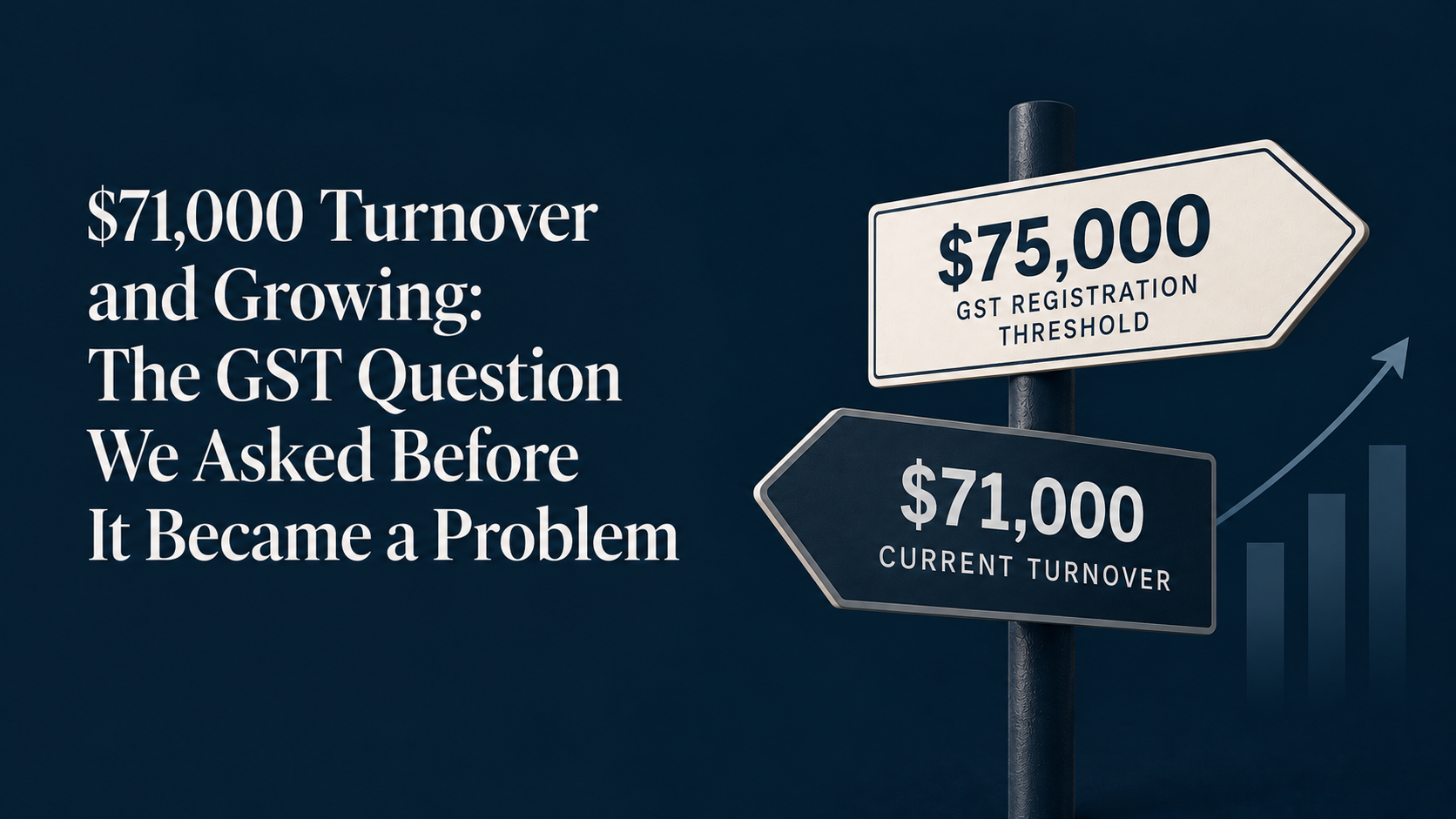
$71,000 Turnover and Growing: The GST Question We Asked Before It Became a Problem
While working with a client, we noticed their business wasgrowing.
They weren't registered for GST, and their GST turnover was around $71,000 — close to the $75,000 registrationthreshold.
We could have simply recorded what the business had earned andmoved on.
Instead, we asked:
“What do you expect your turnover to look like over the next 12months?”
The client expected the business to continue growing.
That mattered because GST registration isn't determined simply bywaiting for historical turnover to physically pass $75,000. The GST turnovertests consider both what has happened and, importantly, the business's projectedGST turnover.
We looked forward, not just backward
For most businesses, the compulsory GST registration threshold is $75,000.
Broadly, current GST turnover looks at the current month andprevious 11 months, while projected GST turnover looks at the current month andnext 11 months, subject to the specific inclusions and exclusions under the GSTrules.
So a growing business sitting at approximately $71,000 shouldn'tnecessarily think:
“I'm under $75,000, so GST isn't something I need to worry aboutyet.”
We discussed where the client's turnover was heading and whetherthe projected GST turnover test could require registration.
That gave the client an opportunity to deal with GST proactivelyrather than discovering the obligation after the event.
Missing registration can become expensive
If a business becomes required to register for GST but continuesmaking taxable sales without properly allowing for GST, not charging a separateGST amount doesn't necessarily make the liability disappear.
The business can potentially become liable for GST on taxablesales from the date it should have been registered.
By the time the problem is discovered, going back to customers andcollecting additional money may be difficult or commercially impractical.
For example, suppose the business subsequently made $110,000of taxable sales withoutallowing for GST in its pricing.
If those amounts were effectively treated as GST-inclusive, theGST component could be approximately $10,000.
That could mean thousands of dollars coming out of money thebusiness had already received — and potentially already spent.
The longer the problem continued, the larger the exposure couldbecome.
Growth can change your tax obligations
There wasn't an ATO audit or an existing GST problem to fix.
The value was identifying the issue beforeit became one.
Because the client's business was approaching the threshold andexpected to continue growing, we could consider the registration requirementsand prepare for the potential impact on pricing, invoicing, bookkeeping, BASobligations and cash flow.
The client's business hadn't done anything wrong.
It had simply grown to the point where the tax obligations neededto grow with it.
A $71,000 turnover figure isn't necessarily just a number in theaccounts.
It can be a reason to ask:
“Whathappens next?”
This case study has been generalised and certain details have beenchanged to protect client and business confidentiality. General informationonly. GST registration requirements depend on the nature of the enterprise andthe current and projected GST turnover tests, including applicable inclusionsand exclusions. The general compulsory registration threshold is $75,000 forbusinesses and $150,000 for non-profit organisations, with differentrequirements applying in some circumstances.
The Cost of Paying Superannuation Late: More Than $50,000 of Deductions Lost
Paying employees' superannuation late can look like anadministrative problem.
For one of our business clients, historical late payments hadcontributed to more than $50,000 of superannuationcosts becoming non-deductible, together with exposure to theSuperannuation Guarantee Charge (SGC), interest and other complianceconsequences.
When we reviewed the client's affairs, we identified that employeesuperannuation had repeatedly not been dealt with within the requiredhistorical payment timeframes.
By the time we identified the pattern, the tax consequences werealready significant.
Paying the super later didn't necessarily fix the tax problem
Under the rules applying to the historical periods involved,failing to make the required superannuation contributions by the applicablequarterly due dates could result in an SGC liability.
That mattered because SGC itself is not tax deductible.
Late contributions also required specific treatment. Depending onthe circumstances, an eligible late contribution could potentially be used as alate-payment offset against the SGC or carried forward towards a futurequarter. Those alternatives could have different deduction consequences.
For this client, after reviewing the historical payments and theirtreatment, more than $50,000 of superannuation costs hadultimately become non-deductible.
The cash had still left the business.
The employees' super obligations still had to be dealt with.
But the business had lost deductions it could otherwise haveobtained if the obligations had been managed correctly and on time.
The flow-on effect could extend beyond the deduction
A lost deduction can also affect the broader tax position.
If an expense is non-deductible, the taxable income of the companyor trust may be higher than it otherwise would have been.
Depending on the structure, that higher taxable income can thenhave flow-on consequences when profits are ultimately dealt with — for examplethrough company dividends or trust distributions.
The precise outcome depends on the entity, available frankingcredits, beneficiaries or shareholders and their individual tax positions.
The important point is that the cost of getting super wrong isn'tnecessarily limited to the super payment itself.
The rules have now changed — but payment timing matters even more
This case arose under the historical quarterly superannuationsystem.
From 1 July 2026, Payday Super changed thetiming of employers' super guarantee obligations.
Employers now calculate super guarantee on qualifying earningsassociated with each payday, and contributions generally need to be received bythe employee's super fund within 7 business days after payday,unless an extended timeframe applies.
That makes payroll systems, payment processing and monitoring evenmore important.
For this client, we couldn't go back and change the historicalpayment dates.
What we could change was the process.
Rather than discovering late super when preparing accounts or taxreturns months later, the objective was to build the obligation into theclient's ongoing payroll and compliance systems so problems could be identifiedbefore they became expensive.
More than $50,000 of lost deductions was a costly reminder:
Superannuation isn't paid on time simply because the payment waseventually made. The timing and treatment matter.
This case study has been generalised and certaindetails, including financial amounts, have been changed to protect client andbusiness confidentiality. It includes historical superannuation guaranteeobligations applying before the introduction of Payday Super on 1 July 2026.General information only. The consequences of late superannuation paymentsdepend on the period involved, the nature and timing of the contribution,applicable SGC rules and how late contributions are treated. From 1 July 2026,different Payday Super rules apply and employers should consider therequirements applicable to each payday.
The Shares Looked Free — But Their Cost Base Wasn't Zero
Employee shares can create a common misunderstanding.
A client had accumulated a substantial shareholding over a numberof years through an Employee Share Scheme (ESS),together with additional shares acquired through DividendReinvestment Plans (DRPs).
Like many employees, the client had viewed some of the ESS sharesas effectively a benefit or incentive received from their employer.
But for tax purposes, receiving shares without personally payingthe market price for them does not necessarily mean they have a nilcost base.
And that became particularly important when the shares wereeventually sold.
The capital gain didn't look right
When we reviewed the client's share transactions, the apparentcapital gain was substantial.
Rather than simply accepting the available acquisition figures, weasked:
How were these shares originally acquired, and had the clientalready been taxed on any of their value?
That led us back through the client's Employee Share Schemehistory.
Depending on the particular ESS and the applicable tax rules, anemployee may have an amount included in their assessable income in relation toshares or rights received under the scheme.
The employee may therefore have already been taxed on valueassociated with those shares even though they did not purchase them in theconventional way.
That history can be critical when subsequently determining the CGTcost base.
We reconstructed the ESS history
We investigated the client's ESS records, including the relevantacquisition and taxing events and amounts previously brought to account forincome-tax purposes.
We then considered the CGT cost-base treatment of the resultingshares under the applicable ESS and CGT rules.
The result was a significantly higher tax cost base thanwould have been produced by simply treating the shares as having been acquiredfor little or no cost.
That, in turn, significantly reduced the client'scapital gain.
The important point wasn't simply the final number.
It was recognising that the client's historical ESS taxation couldaffect the tax treatment when those shares were eventually sold.
Dividend reinvestment plans can create a similar record-keepingproblem
We also see a related issue with Dividend Reinvestment Plans.
Under a DRP, instead of receiving a dividend entirely in cash, theshareholder uses the dividend to acquire additional shares.
The dividend may still be assessable income, while the newlyacquired shares have their own acquisition details for CGT purposes.
Over many years, this can result in numerous separate parcels ofshares with different acquisition dates and cost bases.
If those historical DRP acquisitions aren't properly captured whenthe shares are eventually sold, the calculated capital gain can be overstated.
Don't assume the number in front of you is the tax cost base
This case was a good example of why we don't simply accept theapparent gain generated from incomplete share records.
For long-held investments,we may need to understand how the shares came into existence inthe first place.
Were they purchasednormally?
Were they received throughan ESS?
Was an amount previously taxed under the ESSprovisions?
Were additional sharesacquired through a DRP?
Were there multiple parcelsacquired over many years?
Those questions canmaterially change the CGT calculation.
A share may have cost the client little or nothing out of pocket —but that doesn't necessarily mean its tax cost base is zero.
General information only. The taxation of EmployeeShare Schemes and the CGT cost base of ESS shares depend on the particularscheme, applicable Division 83A and CGT provisions, relevant taxing events,amounts previously included in assessable income and other circumstances. DRPshares generally require consideration of each relevant acquisition andassociated tax records. The treatment of a particular shareholding should bedetermined from the relevant documentation and applicable tax law. This casestudy has been generalised and certain details have been changed to protectclient confidentiality.
A $3 Million Business Acquisition: Looking Beyond Accounting Profit
A client was considering acquiring an established real estateagency for approximately $3 million.
The business had an established rent roll generating recurringproperty-management income, together with a sales division generatingcommission income.
There were historical financial statements and independentvaluation reports available.
But before committing $3 million — and taking on substantialacquisition finance — we wanted to answer a more important question:
After the client buys the business, will it generate enough cashto operate comfortably and service the acquisition debt?
Historical profit was only the starting point
We reviewed several years of financial information and theindependent valuation reports, but we didn't simply take the reported profitand assume it would continue.
The business had different revenue streams with differentcharacteristics.
An established rent roll could provide relatively recurringmanagement fee income, while sales commissions could fluctuate considerablydepending on transaction volumes, market conditions and the performance of thesales team.
We therefore looked at what was driving the business: the size andquality of the rent roll, recurring and ancillary management income, historicalsales commissions, staffing and commission costs, premises and operatingexpenses, maintainable earnings and working-capital requirements.
We also compared relevant aspects of the business againstavailable real estate industry benchmarks.
The objective wasn't to assume the business should perform exactlylike an industry average. Benchmarking gave us another reference point foridentifying unusual costs or margins and testing whether the assumptions beingused in the acquisition model appeared commercially supportable.
Then we modelled what happened after the purchase
Historical accounts tell you what happened under the previousowner.
The client needed to understand what could happen afterpaying $3 million for the business and taking on the acquisition debt.
We prepared a forward-looking cashflow forecast incorporating theexpected revenue and operating costs, working-capital requirements and proposedacquisition funding.
Importantly, we modelled both interest and principal repayments.
That distinction matters.
Interest affects accounting profit. Repayment of loan principalgenerally doesn't appear as an expense in the profit and loss statement — butthe cash still has to leave the business.
A business can therefore look profitable on paper while havingsignificantly less cash available after servicing the debt used to buy it.
We also tested what happened if some of the assumptions changed.What if sales commissions were lower? How much of the income was recurring?What level of staffing did the business actually require? How much workingcapital needed to remain in the business?
Ultimately, the question became:
After paying the employees, operating expenses, working capitalrequirements, interest and principal repayments, was there still enough cashflow and headroom for the acquisition to make sense?
The model helped turn a $3 million decision into somethingmeasurable
The forecast also formed part of the financial informationprepared to support the client's financing process with the lender.
By bringing together the historical financials, valuation reports,rent-roll economics, sales income, staffing costs, industry benchmarking andacquisition finance, the client could see more than whether the business hadhistorically made a profit.
They could see how that profit could translate intocash after acquisition — and whether that cash was expected to support the debtrequired to buy the business.
The client ultimately proceeded with the acquisition.
A $3 million purchase should not be based solely on what thebusiness earned yesterday.
Before buying, we wanted the client to understand:
“If I buy this business, what could the cash flow look liketomorrow — and can it comfortably pay for the debt I am taking on today?”
This case study has been generalised and certain details,including financial amounts, have been changed to protect client and businessconfidentiality. General information only. Business acquisition decisionsdepend on the particular circumstances, including maintainable earnings,revenue composition, working capital, transaction structure, financing termsand industry conditions. Forecasts and benchmarking depend on assumptions andavailable information, and actual results may differ. Our role was to providefinancial, cash-flow and tax analysis and information to support the client'sfinancing process. Lending and credit decisions remain matters for the lenderand, where applicable, an appropriately licensed credit or financeprofessional.
$300,000 of Performance Rights Had Vested — But Was the Tax Actually Due?
A client held approximately 3 million performance rights in a listed company.
During the year, the relevant performance hurdle was achieved andthe rights vested. With the underlying shares worth approximately 10 centseach, the rights represented around $300,000 of underlying share value.
The client understandably thought:
The rights have vested, so the $300,000 must now be taxable.
But with Employee Share Schemes (ESS), the word “vested” doesn't necessarily tell you when thetax is due.
We went back to the actual plan documents
Rather than simply treating the vesting date as the tax event, wereviewed the documentation governing the performance rights.
We looked at when the rights were granted, the performance andforfeiture conditions, what happened when they vested, whether the rights couldbe transferred or disposed of, when they could be exercised, what happened ifthey weren't exercised, and what restrictions applied to any resulting shares.
That distinction mattered.
Although the performance hurdle had been achieved, the rights hadnot yet been exercised and converted into ordinary shares. The rightsthemselves were subject to restrictions under the scheme and would lapse ifthey were not exercised by the relevant expiry date.
We therefore needed to determine whether vestinghad actually triggered the deferred taxing point under Division 83A — orwhether the taxing point occurred later under the particular terms of thescheme.
Vesting and taxing aren't necessarily the same event
Tax-deferred performance rights have specific rules determiningwhen the ESS deferred taxing point occurs.
Depending on the nature of the rights and the scheme terms,relevant considerations can include whether there remains a real risk offorfeiture, whether the rights have been exercised, and whether the schemegenuinely restricts disposal of the rights or resulting shares.
Based on our review of the documentation applying to theseparticular rights, vesting itself did not trigger thedeferred taxing point.
That meant approximately $300,000 of underlying share value thatthe client thought might need to be dealt with in the current year's tax returncould instead fall into a later income year.
This wasn't a $300,000 tax saving.
The ESS income still needed to be recognised when the relevanttaxing point occurred, and the assessable amount would depend on the valuedetermined under the ESS rules at that time.
What we identified was a tax deferral — potentially with significant cashflowand tax-planning implications.
With ESS, the documents matter
Performance rights can involve several important dates:
grant → vesting → exercise → taxing point → eventual sale
Those dates aren't necessarily the same.
Simply seeing that performance rights had “vested” andautomatically treating that as the tax event could therefore produce the wrongoutcome.
For this client, the important question wasn't simply:
“What is the value of the vested rights?”
It was:
“What do the plan documents actually say happened to the rights —and when does Division 83A say the tax becomes payable?”
With approximately $300,000 of underlying value involved,getting that distinction right mattered.
This case study has been generalised and certaindetails, including quantities and values, have been changed to protect clientand business confidentiality. General information only. Employee Share Schemetaxation depends on the applicable Division 83A provisions, when the ESSinterests were acquired, the nature of the rights, the specific schemedocumentation and the taxpayer's circumstances. Grant, vesting, exercise, realrisk of forfeiture, genuine disposal restrictions, disposal and other eventscan affect the timing and amount of taxation. The 30-day disposal rule may alsoalter the deferred taxing point in relevant circumstances.

Why Keep Everything in One Company? Separating Business Risk, Valuable Assets and Property
Many businesses start with one entity.
The company employs the staff, signs the customer contracts, ownsthe equipment, holds the cash and carries on the day-to-day business.
When the business is small, that simplicity can make sense.
But as one client's business grew and accumulated increasinglyvaluable assets, we asked a different question:
Should millions of dollars of valuable assets continue sitting inthe same entity carrying the day-to-day operating risk?
The operating company was doing everything
An operating business can be exposed to risk through employees,customers, suppliers, contracts, finance arrangements and its everydayactivities.
At the same time, a successful business can accumulate substantialassets.
For a transport business, that might include trucks and trailersworth hundreds of thousands or even millions of dollars. In manufacturing orconstruction, it could be machinery, plant and other valuable equipment.
Rather than automatically allowing everything to accumulate in theoperating company, we considered whether the structure should separate:
the business that takes the operating risk from the entities thathold appropriate long-term valuable assets.
For example, a separate asset entity could potentially ownappropriate trucks, machinery or equipment and make those assets available tothe operating company under properly documented commercial arrangements.
The operating company could then focus on employing staff,contracting with customers and carrying on the day-to-day business.
That doesn't make valuable assets untouchable or eliminatecommercial risk. Financing arrangements, securities, guarantees, insolvency lawand the legal structure can materially affect the protection actually achieved.
But it starts with a more deliberate question:
What needs to be exposed to the operating business — and whatdoesn't?
The charges between entities still need to be commercial
Creating another entity doesn't give a business licence to moveprofit wherever it wants.
If one entity genuinely provides assets or services to another,there may be legitimate hire, lease or service charges between them. But thosearrangements need commercial substance.
The assets or services must be provided, the charges need a properbasis and the arrangements should be appropriately documented.
We don't simply reach 30 June; decide the operating company hasmade “too much profit” and create an arbitrary management fee to move incomeinto another entity.
The structure comes first. The transactions between the entitiesthen need to reflect what is happening commercially.
Property deserved its own decision
We applied the same thinking when considering long-term businessproperty.
If the client eventually acquired commercial premises, should theoperating company automatically own the property as well?
Not necessarily.
Commercial property can become one of the most valuable assets ina business owner's overall wealth. Holding it separately from the operatingbusiness may therefore warrant consideration, depending on the tax, legal,financing, asset-protection and succession objectives.
For some business owners, an SMSF may also be one structure worthinvestigating for qualifying business real property, subject to thesuperannuation rules, investment strategy, related-party requirements,financing and the client's broader retirement circumstances.
But there is no universal answer.
The objective isn't to create as many entities as possible.
Every entity should have a reason to exist.
Structure should evolve as the business evolves
A structure that made sense when a business had two employees and$100,000 of equipment may not remain appropriate when it has dozens ofemployees, substantial contracts, valuable equipment and commercial property.
That's why we don't look at business structures as something thatshould be established once and then ignored indefinitely.
As the business grows, we review what each entity is doing, wherevaluable assets are accumulating, where the commercial risks sit and whetherthe existing structure still supports the owner's longer-term objectives.
Sometimes the question isn't:
“Do we need another company?”
It's:
“Why is this particularasset sitting in the operating company in the first place?”
This case study has been generalised, and certaindetails have been changed to protect client and business confidentiality.General information only. Separating assets and operating activities does notguarantee asset protection. Tax, GST, CGT, duty, financing, security,insolvency and other consequences should be considered before transferringexisting assets or establishing new arrangements. Related-party hire, lease andservice arrangements must have appropriate commercial and tax support.Asset-protection and legal structuring should be considered with anappropriately qualified lawyer. SMSF ownership of business real property issubject to specific superannuation laws and should be separately assessedbefore implementation.

$900,000 Revenue and a Prime Location — But Was the Cafe Worth $180,000?
A client came to us considering buying an established café forapproximately $180,000.
On the surface, it looked attractive: a prime location, strongfoot traffic, an established customer base and approximately $900,000in annual revenue.
But before our client invested $180,000, we wanted to knowsomething more important:
What was the business actually earning?
$900,000 of revenue didn't mean $900,000 of value
We reviewed several years of financial statements.
Despite the significant turnover, profitability had been low andinconsistent, including both profitable and loss-making years. There was littleevidence of strong, maintainable earnings after the operating costs of thebusiness.
That mattered because a purchaser isn't buying turnover.
They're buying the opportunity to generate future profits and cashflow.
Was the client buying a business — or buying themselves a job?
The café employed a manager, so we also considered what thenumbers could look like if our client bought the business and personallyperformed that role.
Removing the manager's wage made the owner-operator earnings lookbetter.
But that didn't automatically make the café a better investment.
We needed to distinguish between:
the amount the client was effectively earning for working in thecafé; and
the return generated on the $180,000 of capital they wereinvesting.
If most of the apparent profit only arises because the purchaserreplaces an employee and works in the business themselves, a substantial partof that “profit” may really represent remuneration for their labour.
A business should therefore be assessed after allowing anappropriate commercial wage for the work the owner is expected to perform.
Only then can you properly assess what return the business itselfis generating on the capital invested.
The numbers didn't support the $180,000 price
We considered the café's historical and maintainable earnings, theowner's required involvement, an appropriate commercial wage, the assets beingacquired and the return available on the client's investment.
We also considered what the client was taking on: $180,000of capital at risk, together with the operationalresponsibilities and risks of running a hospitality business.
Based on the financial information and assumptions we reviewed, weweren't satisfied that the maintainable earnings supported paying approximately $180,000 for the business.
The client ultimately decided not to proceed.
That didn't mean the café had no value.
It meant the numbers didn't support theinvestment for our client at that price.
A prime location, busy premises and $900,000 of annual revenue canmake a business look successful from the outside.
But before buying a business, the more important questions are:
What does it earn after allowing a commercial wage for the owner'swork — and is the remaining return enough to justify the capital and riskinvolved?
For this client, answering those questions helped them walk awayfrom a $180,000 investment that didn't stack upfinancially.
This case study has been generalised, and certain details havebeen changed to protect client and business confidentiality. Generalinformation only. Business acquisition and valuation decisions depend onfactors including maintainable earnings, normalisation adjustments, assetvalues, owner involvement, lease terms, working capital requirements, financingand industry conditions. Our role was to provide financial and tax analysis ofthe proposed acquisition. Legal matters should be considered with anappropriately qualified lawyer, while lending and credit matters may requireadvice from an appropriately licensed credit adviser.

A $210,000 Luxury Car: Why Buying It Through the Business Wasn't Automatically the Best Option
A client wanted to buy a $210,000 luxury car.
Their business had sufficient cash available, so the obviousquestion was:
Should the business buy it?
At first glance, buying an expensive vehicle through a businesscan sound attractive. There may be depreciation deductions, GST credits andother tax consequences to consider.
But the client expected the vehicle to be used predominantly forprivate purposes.
That changed the analysis.
The $210,000 purchase price didn't mean a $210,000 tax deduction
For a luxury passenger vehicle, the tax deductions and GST creditsaren't necessarily based on the full purchase price.
For example, the car depreciation limit for the 2025–26income year was $69,674. Subject to the particular vehicle andapplicable rules, that meant the business couldn't simply depreciate the entire$210,000 purchase price for income-tax purposes.
If the vehicle was also used privately, the deductible amountwould need to reflect the relevant business use.
The GST credit was similarly capped. For 2025–26, the maximum GSTcredit for a car above the car limit was generally $6,334,unless an exception applied.
So even before considering FBT, buying the car through thebusiness didn't mean the client would obtain tax deductions based on the entire$210,000 cost.
Then there was potentially around $42,000 of FBT taxable value
Where an employer provides a car that is available for anemployee's private use, a car fringe benefit can arise.
Under the statutory formula method, the taxable value broadlystarts with the car's base value and applies a 20%statutory rate, adjusted for the period the car was availablefor private use and any recipient contributions.
For a $210,000 vehicle available for private use for a full FBTyear, a simplified illustration gives:
$210,000 × 20% = approximately $42,000 of gross FBT taxable value.
That isn't $42,000 of FBT itself. It is the approximate taxablevalue before considering matters such as recipient contributions and theprecise FBT base value.
The operating cost method may produce a different result where therequired records are maintained and there is sufficient business use. But evenif a logbook supported substantial business use for FBT purposes, that wouldn'tremove the separate income-tax depreciation limitation applying to a luxurypassenger vehicle.
The client therefore couldn't simply look at a $210,000 purchasethrough the business and assume the tax deductions would outweigh theprivate-use consequences.
Then we looked at another source of cash
When we reviewed the client's broader position, we identified thatan associated trust already owed money to the client.
That was important.
Repayment of genuine loan principal is fundamentally differentfrom extracting additional taxable profits from a company or trust.
Rather than automatically purchasing the vehicle through thebusiness, we considered whether amounts genuinely owing to the client could berepaid and used towards purchasing the vehicle personally.
That could avoid unnecessarily placing a predominantly private-useluxury vehicle inside the business structure.
The client also had personal investments available, so the broaderdecision became whether to use existing personal cash and loan repayments, sellinvestments, borrow, or use some combination of those options.
At that point, the decision wasn't purely a tax question.
Tax was one input into the decision — not the reason to buy thecar
The client was already in a high marginal tax bracket, so sellinginvestments or generating additional taxable income purely to fund the purchasealso needed to be considered carefully.
We analysed the tax consequences of the available funding optionsand worked alongside the client's licensed financial adviser on the broaderfinancial decision, including the implications of retaining or sellinginvestments and using cash versus debt.
Ultimately, the client was able to purchase the $210,000vehicle personally using available cash, including repayment of genuine amountsalready owing to them, rather than automatically putting thecar through the business.
The point wasn't that a luxury car should always be purchasedpersonally.
For another client, depending on business use, ownershipstructure, FBT position, financing and other circumstances, business ownershipmay produce a different result.
The important thing was that we didn't start with:
“How can we claim the car?”
We started with:
“You want to buy the car. What is the most appropriate way to ownand fund it?”
This case study has been generalised and certaindetails have been changed to protect client and business confidentiality.General information only. The $42,000 figure is a simplified illustration ofgross taxable value under the statutory formula method, assuming a $210,000 FBTbase value and full-year availability, before recipient contributions and otheradjustments. Actual FBT outcomes depend on the vehicle, base value,availability, method used, business and private use and other circumstances.Income-tax depreciation and GST limitations may separately apply. Loanrepayments must represent genuine amounts owing. Our role was to advise on thetaxation consequences of the alternatives. Investment and financial productadvice should be obtained from an appropriately licensed financial adviser, andcredit advice may require an appropriately licensed credit adviser.

The Trust Owed Them $150,000 — So Why Keep Drawing More Taxable Cash?
A husband and wife were regularly receiving salary from theirfamily trust to fund their personal living expenses.
There was nothing unusualabout that on its own.
But when we reviewed thetrust's balance sheet and tax position, two things stood out:
- the trust already owed the husband and wife approximately $150,000 — $75,000 each; and
- the trust had carried-forward tax losses available.
That raised a differentquestion:
Why keep generatingadditional taxable salary purely to provide personal cash flow when the trustalready owes the clients $150,000?
The $150,000 was already owing to them
The clients' loan accountsrepresented genuine amounts owing by the trust.
Repaying genuine loanprincipal is fundamentally different from paying salary or making a trustdistribution. A repayment of money genuinely owing to the clients would notordinarily become additional assessable income merely because the debt wasrepaid.
We therefore consideredtemporarily reducing the salary being paid and instead progressively repayingthe existing loan balances.
That could provide thehusband and wife with access to up to $150,000 already owing to them,while reducing the PAYG withholding cash-flow obligations associated withcontinuing to pay salary during that period.
But reducing salary affected the trust too
We couldn't look at theclients' personal cash flow in isolation.
If the trust stoppedincurring otherwise deductible salary expenses, its taxable income couldincrease.
Normally, that could simplymove the tax problem somewhere else.
But this trust had anotherexisting tax attribute: carried-forward revenue losses.
Subject to the trustsatisfying the applicable loss-recoupment rules and having sufficient lossesavailable, those losses could potentially be applied against the trust'sincreased taxable income.
That meant the strategyneeded to be considered as a whole:
reduce salary for a period →repay genuine amounts already owing to the clients → reduce PAYG withholdingcash-flow obligations → potentially utilise existing trust tax losses againstthe resulting increase in taxable income.
The opportunity was already sitting inside the structure
We didn't create anotherentity or manufacture a new deduction.
The trust already owed theclients approximately $150,000.
The carried-forward taxlosses already existed.
And the clients alreadyneeded personal cash flow.
The opportunity came fromrecognising that those existing positions could potentially work togetherrather than automatically continuing the same salary arrangement year afteryear.
Sometimes the most usefultax planning starts with the balance sheet.
Before creating more taxablepayments, first ask:
“Does the entity already oweyou money?”
This case study has been generalised and certaindetails have been changed to protect client and business confidentiality.General information only. The availability and utilisation of carried-forwardtrust losses are subject to the applicable trust loss provisions and theparticular circumstances of the trust. Loan balances must represent genuineamounts owing and should be verified before repayment. The tax treatment ofpayments from a trust depends on their legal and accounting character. Salary,trust distributions and repayment of genuine loan principal can have materiallydifferent tax consequences.
Stay Ahead with Business & Tax Insights
Receive practical business insights, taxation updates and strategic guidance delivered directly to your inbox. Stay informed about legislative changes, emerging opportunities and practical strategies to help you structure, grow and protect your business.

Recognised professional credentials and technology partnerships that demonstrate our commitment to technical excellence and ongoing professional development.






Don't wait until tax time to ask the important questions.
The Tax Bar Australia provides proactive tax and business advice designed to help you make informed decisions before opportunities are missed or problems arise.