
Real situations. Better questions. Smarter decisions.
Tax and business decisions rarely come down to a single number.
The right question at the right time can uncover a better tax outcome, identify a risk, improve cash flow or change the way a business decision is approached.
Explore real-world examples of how we have helped clients look beyond the obvious and make more informed financial decisions.

The Hospitality Business Was Turning Over $1.5 Million — But Nobody Knew What It Was Making Each Month
The Hospitality Business WasTurning Over $1.5 Million — But Nobody Knew What It Was Making Each Month
A hospitality business was turning over approximately $1.5million a year.
Sales were strong. The business was busy. Staff were working.
But there was a fundamental problem:
The owners couldn't clearly see what the business was actuallymaking each month.
The bookkeeping was being completed, but the accounts weren'tproducing reliable monthly management information.
Before we could talk about improving profitability, we firstneeded numbers we could trust.
First, we fixed the numbers
We reviewed the bookkeeping and month-end processes and identifiedseveral issues affecting the accuracy of the monthly results.
Among other things, we:
· moved equipment purchasesthat had incorrectly been expensed through the profit and loss statement to thebalance sheet where appropriate;
· cleaned up the chart ofaccounts so revenue, cost of goods sold and operating expenses could beproperly analysed;
· introduced trackingcategories to provide better visibility over the business;
· developed proper month-endprocedures;
· brought cash sales andundeposited cash into the accounts;
· reconciled uncleared salesamounts from Epos Now; and
· accrued wages into thecorrect reporting periods.
None of these changes, by themselves, were the objective.
The objective was to produce financial information that actuallyshowed what was happening in the business each month.
Once the accounts were reliable, we could start asking betterquestions.
Then we benchmarked the business
We didn't just compare this month with last month.
We compared the business against external industry information,including specialist industry benchmarkingreports, ATO small business benchmarks and IBISWorld industry research,where relevant.
We considered measures such as cost of goods sold, gross margins,labour costs, overheads, net profit margins and sales patterns.
Benchmarking wasn't the answer by itself.
It helped us identify where the business was performingdifferently and where we needed to investigate further.
We could then work through the underlying drivers of profitability— including purchasing and cost of goods sold, labour efficiency, pricing,operating hours, overheads and other areas affecting margins.
For example, one area we investigated was labour.
Rather than simply looking at the total annual wage bill, weasked:
Were all of the hours the business was open actually profitable?
By comparing sales patterns across different operating hours withthe staffing required during those periods, we could identify times when thebusiness was generating revenue but potentially very little profit after labourand other operating costs.
That gave the owners a better basis for making decisions aboutstaffing levels and operating hours.
We also looked at cost of goods sold and gross margins.
One of the areas reviewed was the cost of providing free meals tostaff. The business moved from providing free staff meals to a discountedarrangement, among other changes designed to improve the amount of gross profitretained from each dollar of sales.
These were only some of the areas addressed.
The broader objective was to understand what was drivingprofitability and identify practical changes that could improve the bottomline.
Revenue wasn't the problem
A business turning over $1.5 million can still underperform.
The objective wasn't simply to increase sales.
It was to improve the amount of profit being retained from thesales the business was already generating.
Reliable monthly reporting gave us the starting point.Benchmarking helped identify where to look. More detailed analysis helpedidentify what could actually be changed.
Following the changes to the financial reporting and theoperational decisions that came from the analysis, withina few months, net profit had increased by approximately 7%.
The improved profitability and reporting also gave us a muchclearer basis for considering remuneration for the working directors, ratherthan making those decisions without reliable information about the underlyingperformance and cash requirements of the business.
Bookkeeping should tell yousomething
Accurate bookkeeping is essential.
But for a growing business, getting the transactions into theaccounting system is only the starting point.
Good monthly reporting should help answer questions such as:
What is actually driving our profit?
How do our margins compare with similar businesses?
Where are we losing margin?
Are our wages appropriate for the sales we're generating?
Are all of our operating hours commercially worthwhile?
What can we change to improve the bottom line?
Because the goal isn't simply to have higher revenue.
The goal is to build a more profitable business.
This case study has been generalised and certain details have beenchanged to protect client and business confidentiality. Benchmarkinginformation should be considered in the context of the particular business andshould not be treated as a substitute for analysis of its actual circumstances.
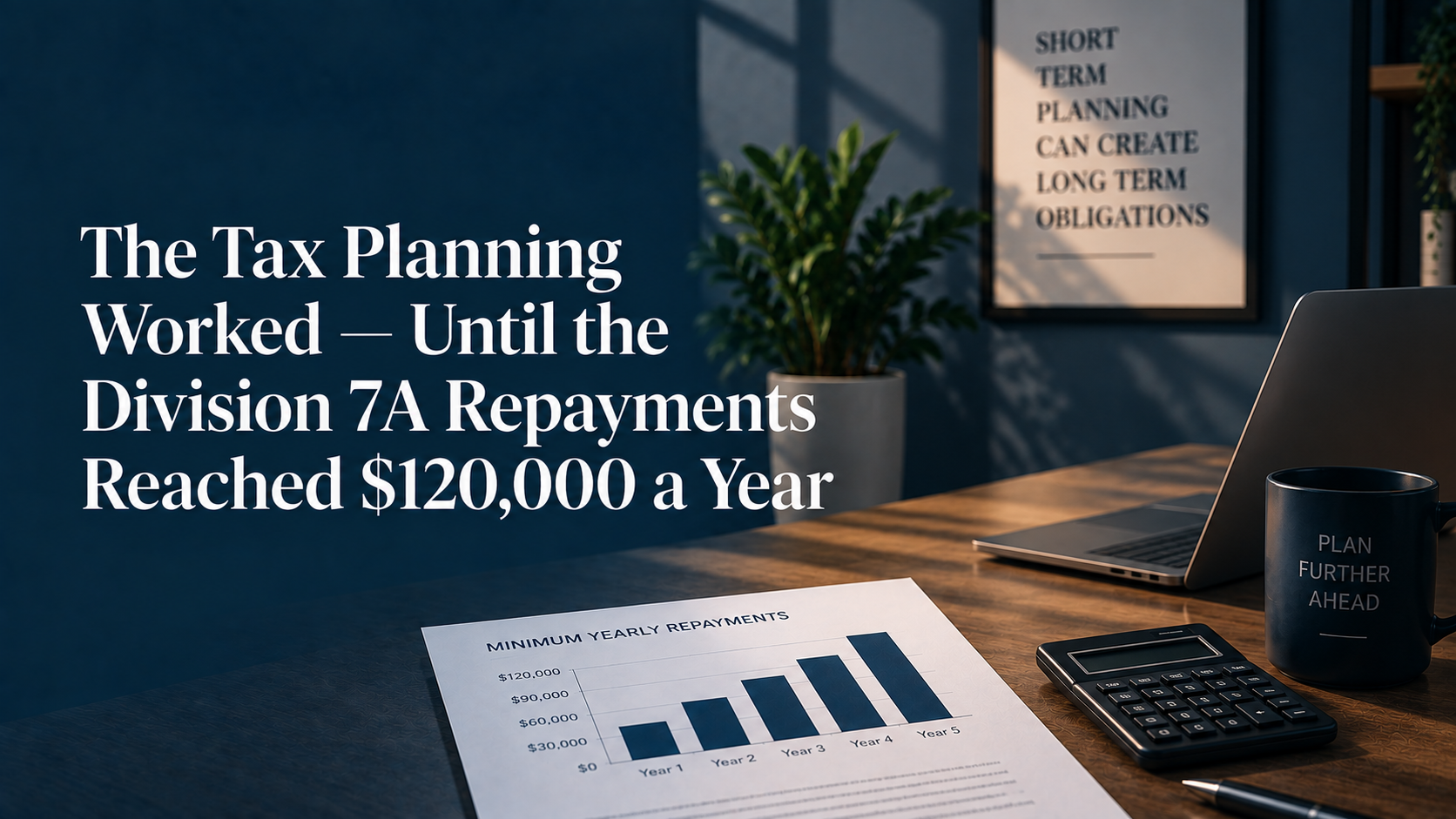
The Tax Planning Worked — Until the Division 7A Repayments Reached $120,000 a Year
For several years, a business owner had been managing theirpersonal taxable income while regularly redrawing money from their privatecompany.
The strategy worked when viewed one year at a time.
Their salary was being managed so that their personal taxableincome remained around the 30% marginal tax bracket,while additional amounts drawn from the company accumulated as Division 7Aloans.
The loans had been put on complying terms.
But the balances weren't disappearing.
As the loans accumulated over several years, so did the minimumyearly repayment obligations.
Eventually, the client's combined minimum yearly repayments hadreached approximately $120,000 a year.
Where those repayments were being dealt with through dividendsfrom the company, the dividends, together with the client's existing salary,were now pushing part of their taxable income into the 45%marginal tax bracket.
The tax planning had worked in the earlier years.
But eventually, it started to catch up.
The tax had been deferred — noteliminated
A complying Division 7A loan can prevent an amount from beingtreated as a deemed dividend at the time the loan is made, provided therelevant requirements are satisfied.
But putting a loan on complying terms doesn't make the debtdisappear.
Interest accrues and minimum yearly repayments generally need tobe made over the term of the loan.
For several years, the strategy had allowed the client to accessadditional company funds while managing their immediate personal taxableincome.
The problem became apparent when we looked at the position overmultiple years rather than one financial year at a time.
Each additional loan created another future obligation.
Eventually, the accumulated minimum yearly repayments had reachedapproximately $120,000 a year. Wherethose repayments were being dealt with through dividends from the company, thetaxable income required to service the loans, together with the client'ssalary, was now pushing part of their income into the 45%marginal tax bracket.
What had appeared to be tax minimisation in the earlier years was,to a significant extent, tax deferral.
The problem wasn't the Division 7Aloan agreement
The loans had been put on complying terms.
So simply preparing another loan agreement or calculating anotherminimum yearly repayment wasn't the answer.
The bigger issue was that the strategy had been repeated withoutsufficient consideration of where the accumulated loans would eventually lead.
The client was also continuing to redraw money from the company.
That created the possibility of repaying old Division 7A loans whilesimultaneously creating new ones.
So we needed to look beyond the annual compliance requirements andconsider the client's broader strategy for extracting money from the company.
That meant considering the existing loan balances, future personalcash requirements, salary, available franking credits, company cash flow andhow the loans could progressively be reduced without simply allowing the samecycle to continue.
Tax planning shouldn't stop at 30June
A strategy that reduces taxable income today can still createobligations that need to be dealt with tomorrow.
In this case, the issue wasn't that Division 7A had been ignored.
The issue was that the strategy had been repeated withoutsufficient consideration of where the accumulated loans would eventually lead.
Good tax planning therefore asks more than:
“What does this save this year?”
It should also ask:
“Where does this leave the client five or seven years from now?”
Because sometimes the tax hasn't disappeared.
It's simply been deferred to another year.
This case study has been generalised and certain details have beenchanged to protect client and business confidentiality. General informationonly. Division 7A outcomes depend on the particular payments, loans,agreements, repayments, timing and other circumstances involved.

The Salon Was Making Money — So Where Was the Rent?
Sometimes the numbers that are missing from a set of accounts canbe just as important as the numbers that are there.
We were reviewing the tax position of a sole trader operating asalon business. The business was generating revenue and had the usual expensesassociated with providing its services.
But one thing stood out.
There was no rent or other premises expense.
A salon has to operate somewhere.
So before simply preparing the tax return from the figuresprovided, we asked:
“Where are you actually operating the salon from?”
The business was operating from a dedicated room at home
The client explained that they were renting their home and had aseparate room set aside for operating the salon.
That changed the tax analysis.
For a sole trader operating a business from home, there is animportant distinction between simply doing some administrative work from homeand having part of the home that genuinely has the character of a placeof business.
In this case, the separate room was being used for the salonbusiness.
That meant we needed to consider whether an appropriate proportionof the client's rent could be claimed as an occupancy expense, together withrelevant running expenses associated with operating the business from theproperty.
The deduction wasn't automatically the entire rent. The businessand private use of the property needed to be appropriately separated, and theclaim supported by the client's circumstances and records.
Rent wasn't the only expense worth reviewing
Once we understood where the business was actually operating, theconversation went beyond rent.
We also considered whether an appropriatebusiness portion of other costs associated with operating the salon from therented home had been captured, such as electricity, cleaning and other relevanthousehold running expenses.
The objective wasn't to find expenses to claimsimply because the client worked from home.
It was to establish whatit genuinely cost to operate the salon from the property and make sure the deductible portionof those costs was properly considered.
Sometimes the missing number is the clue
If we had simply taken the bookkeeping at face value, the taxreturn could have been prepared using the expenses already recorded.
But the profit and loss statement told us something didn't quitemake commercial sense.
The business was operating a salon.
Where was the cost of the premises?
That simple question led us to understand how the businessactually operated and identify expenses that warranted further investigation.
Good tax review isn't only about checking whether the numbersprovided are correct.
Sometimes it's about recognising which number should logically be there —but isn't.
This case study has been generalised and certain details have beenchanged to protect client and business confidentiality. General informationonly. Home-based business deductions depend on the taxpayer's circumstances andthe nature and use of the relevant area. Occupancy expenses such as rent aregenerally only available where the relevant part of the home has the characterof a place of business. Business and private expenses must be appropriatelyapportioned and substantiated. Different considerations can apply where thebusiness is operated through a company or trust rather than by a sole trader.

Before You Buy It for the Tax Deduction, Ask Us First
While preparing a client's tax return, they provided severalexpenses they believed were tax deductible.
These included black work shoes, a blazer, anaccounting course and donations made through GoFundMe.
Unfortunately, none of these particular expenses qualified for adeduction in the client's circumstances.
Shoes and clothing: Conventional clothing and footwear are generally private expenses,even when purchased specifically for work. Different rules can apply toprotective clothing or footwear, occupation-specific clothing and qualifyinguniforms.
Accounting course: Self-education can be deductible where it maintains or improvesskills used in the taxpayer's current income-earning activities.Here, the course was not sufficiently connected with the client's existing roleand was more relevant to broader financial knowledge and possible futureactivities, so it was not deductible.
GoFundMe donations: A genuine donation is not automatically tax deductible. In thiscase, the recipients were not deductible gift recipients (DGRs),so the donations could not be claimed.
Why weencourage clients to ask first
This iswhy we generally recommend clients check with us before making significantdiscretionary or optional purchases where the expected tax benefit is part ofthe decision.
The taxtreatment can be very different from what someone expects. An expense might beprivate and not deductible, partly deductible because of mixed use, deductibleover time through depreciation rather than immediately, subject to a specificlimitation, or require particular records to substantiate the claim.
The sameapplies around 30 June. Buyingsomething before year-end doesn't turn a private expense into a deduction, andeven a deductible purchase isn't necessarily immediately deductible in full.
Andimportantly, a $5,000 tax deduction doesn't meanreceiving $5,000 back from the ATO. A deduction generallyreduces taxable income. The client still bears the remaining economic cost ofthe purchase.
Sometimeswe'll tell a client:
“Yes,subject to the requirements, you should be able to claim it.”
Sometimes:
“Only part of it may be deductible, so start keeping theserecords.”
And sometimes:
“Buy it if you need it — but don't buy it because you're expectinga tax deduction.”
Ask before the money is spent
Tax treatment is best checked before thetransaction happens.
A quick conversation beforehand can helpdetermine whether an expense is deductible, whether there is a more appropriatelegitimate approach, what records need to be kept and what the realafter-tax cost willbe.
This principle extends well beyond shoes,courses and donations. It can apply to vehicles, equipment, technology,business assets, property expenditure, superannuation contributions and othersignificant transactions wheretax is part of the decision.
Once the money has been spent, some options may no longer beavailable.
Before spending moneybecause you think you'll “claim it on tax”, check the tax treatment first.
Certain facts and details have been generalisedor changed to protect confidentiality. Deductibility depends on the nature ofthe expenditure, its connection with income-earning activities, applicable taxlaw and substantiation requirements.

More Than 5,000 Genuine Business Kilometers — But the Claim Was Capped
While preparing a real estate agent's tax return,we noticed they used their personal vehicle extensively for work.
Between property inspections, appraisals, listings, open homes andclient meetings, the client had genuinely travelled more than 5,000business kilometres during the year.
The issue wasn't whether those additional kilometres were genuine.
They were.
The issue was that the client had been using the centsper kilometre method.
For the 2024–25 income year, the rate was 88cents per kilometre, but the method was limited to a maximum of 5,000business kilometres per car.
That meant the maximum deduction available under that method was:
5,000 km × $0.88 = $4,400
Even though the client had genuinely travelled substantially morethan 5,000 kilometres for business, we couldn't simply claim the additionalkilometres using the cents per kilometre method.
A different approach going forward
Given the client's level of business travel, we suggested that goingforward they consider using the logbook method.
Under the logbook method, there isn't the same 5,000-kilometrecap.
Instead, the client can establish their business-usepercentage andapply that percentage to eligible actual vehicle costs.
Depending on the circumstances, this can include expenses such as:
- fuel;
- registration and insurance;
- servicing and repairs;
- depreciation on the vehicle; and
- the deductible business-use portion of interest on finance used to acquire the vehicle.
We explained that the client would need to keep an appropriate 12-weeklogbook representingtheir normal travel pattern, together with the required odometer and expenserecords.
Once established, a valid logbook can generally be relied upon forup to five years, provided theclient's circumstances haven't changed in a way that requires a new logbook.
Why the method mattered
We weren't trying to find a way around the 5,000-kilometre limit.
For the year being prepared, the client's cents per kilometreclaim was capped despite the additional genuinebusiness travel.
What we identified was an opportunity to improve the position goingforward.
For someone who regularly drives well over 5,000 businesskilometres, particularly where there are significant vehicle running costs,depreciation and finance interest, the logbook method may produce a materiallydifferent deduction.
The actual outcome depends on the client's business-use percentageand eligible costs, which is why the two methods need to be considered based onthe client's circumstances.
The method matters as much as the kilometres
Sometimes a tax return tells us more than what deduction to claimfor the year just finished.
It can tell us what needs to change for the next one.
The client had genuinely travelled more than 5,000 businesskilometres, but the method they were using meant their claim was capped.
Rather than simply processing the same claim and moving on, weexplained the limitation and helped them put the records in place toconsider a more appropriate method going forward.
Forthis client, the immediate claim was capped, but better record-keeping couldsupport consideration of the logbook method in future years.
This case study is based on client circumstances, with certainfacts and financial information generalised or changed to protectconfidentiality. Car expense deductions depend on the taxpayer's circumstances,the nature of the travel, the calculation method used, substantiationrequirements and applicable tax law.

The Commercial Property That Wasn't Just a Rental Property
A client was considering the future sale of a commercial propertythat had increased substantially in value.
The property was owned by a family trust and leased to a companyconnected with the trust. The company operated the family's café business fromthe premises.
At first glance, the tax position could have lookedstraightforward:
The trust owned the property. The company paid rent. The trustreceived rental income.
So was it simply aninvestment property?
Not necessarily.
The important question waswho actually used the property
For the small business CGT concessions, an asset whose main use isto derive rent can generally be excluded from being an active asset.
But there is an important distinction where an asset is used in abusiness carried on by an affiliate or connected entity.
In this case, the tenant wasn't an unrelated third party.
The connected company was using the property to operate thefamily's café business.
That meant the payment of rent between the entities did not, byitself, prevent the property from potentially qualifying as an activeasset.
Instead of simply looking at the rental income appearing in thetrust's accounts, we needed to understand the broader structure:
Who controlled the entities? Were they connected for Division 152purposes? Who actually used the property? What was it used for? And for howlong?
Those questions could materially change the CGT outcome.
Could the capital gain potentially be eliminated?
The property's ownership history raised another important issue.
Where the relevant conditions are satisfied, the smallbusiness 15-year exemption canallow an eligible capital gain to be disregarded entirely.
But owning a commercial property for 15 years isn't enough byitself.
For a trust, additional requirements apply. Among other things,the basic Division 152 conditions must be satisfied, the asset must satisfy therelevant ownership and active-asset requirements, and the trust must satisfythe significant-individual requirements.
Broadly, the relevant significant individual immediately beforethe CGT event must also be 55 or older and the event occur inconnection with their retirement, or they must be permanentlyincapacitated.
Based on the circumstances we reviewed, there appeared to bepotential access to the small business CGT concessions, including thepossibility of the capital gain being disregarded entirely if all of therequirements for the 15-year exemption were ultimately satisfied.
That was a very different starting point from simply saying:
“The trust receives rent, so it's an investment property.”
And if the 15-year exemption wasn't available?
The analysis didn't necessarily end there.
Depending on the circumstances, Division 152 contains otherconcessions that can potentially reduce or defer an eligible capital gain,including the 50% active asset reduction, retirementexemption and small business rollover.
Which concession — or combination of concessions — is appropriatedepends on the particular transaction and taxpayer.
The important point for this client was that the property couldn'tbe analysed in isolation.
On paper:
Family Trust → owned the commercial property
Connected Company → operated the café from the property
Looking only at the trust's accounts showed rental income.
Looking at the broader business structure showed something muchmore important: the property was being used in thefamily's operating business by a connected entity.
That could fundamentally change the Division 152 analysis.
Before treating commercial property as a passive rental investmentfor CGT purposes, ask:
“Who is actually using theproperty — and what are they using it for?”
This case study has been generalised and certainfacts, entity details and financial information have been changed to protectclient and business confidentiality. General information only. Eligibility forthe small business CGT concessions depends on satisfying the requirements ofDivision 152, including the applicable basic conditions, active asset test andadditional conditions for each concession. Connected-entity and affiliaterelationships, aggregated turnover, maximum net asset value, ownership history,business use and significant-individual requirements can materially affect theoutcome. The 15-year exemption has additional requirements and does not applymerely because an asset has been owned for 15 years.

From Employee to Partner: Planning for a $350,000 Profit Entitlement
A medical specialist approached us ahead of a significant careerchange.
From 1 July, they were moving from employee to partner in theirprofessional practice, with an expected annual profit entitlement ofapproximately $350,000, paid throughregular fortnightly distributions.
As an employee, the financial side had been relativelystraightforward. Salary came through payroll, PAYG tax was withheld andsuperannuation was largely dealt with through the employment arrangements.
Becoming a partner changed that.
Rather than waiting until the first year was over and dealing witheverything at tax time, we started planning before the first partnershipdistribution arrived.
How much of the $350,000 could they actually spend?
That was one of the client's most practical questions.
A fortnightly partnership distribution arriving in a bank accountisn't necessarily equivalent to an employee's net salary.
Depending on the arrangements, there may be no employerwithholding sufficient tax before the cash reaches the client.
So we modelled the expected annual position and translated it intoa practical framework for each distribution: how much should be reserved fortax, how much could be allocated towards planned superannuation contributions,and how much could reasonably be treated as available for personal spending andother commitments.
Instead of simply telling the client to “rememberto save for tax,” theyhad a framework for managing their cash from the beginning.
Then we looked at the family trust
The professional firm had confirmed that its partnershiparrangements permitted the client's interest and associated profit entitlementto be structured through an appropriate family trust arrangement.
That created another planning opportunity — but it didn't mean theentire $350,000 could simply be distributed among family members to produce thelowest possible tax bill.
Professional-firm profit allocations are an area of specific ATOscrutiny.
We therefore considered how the partnership arrangement operated,the nature of the client's profit entitlement, the role of the family trust andthe ATO's professional-firm profit allocation framework.
Depending on the precise arrangements, other provisions —including the personal services income rules — can also require consideration.
The objective wasn't:
“How much of the specialist's income can we move to somebodyelse?”
It was:
“What structure is commercially available, legally effective andappropriate under the tax rules — and how should it operate from day one?”
The move to partnership changed more than the client's income
Moving from employee to partner wasn't simply a pay rise.
The client was moving into a different tax and financialenvironment.
We needed to consider the expected partnership profits, familytrust structure, tax provisioning, superannuation and personal cash flowtogether. We also raised broader matters such as professional indemnity andincome protection insurance, with appropriately licensed advice obtained whererequired.
By planning before the transition, the client could start thefirst year knowing how the structure was intended to operate and, just asimportantly, how much of each fortnightlydistribution they could reasonably spend without creating a tax cash-flowproblem later.
A $350,000 profit entitlement sounds like an income question.
For this client, the more important question was:
“I'm becoming a partner — what needs to change before the firstdollar arrives?”
This case study has been generalised and certain details,including financial amounts, have been changed to protect client and businessconfidentiality. General information only. Professional-firm structures andprofit allocations depend on the particular legal and commercial arrangementsand applicable tax law. PCG 2021/4 provides an ATO compliance-risk frameworkfor certain professional-firm profit allocation arrangements and does notitself determine the underlying tax treatment. Personal services income rulesmay also require consideration depending on the circumstances. Trustdistributions, superannuation contributions and other tax outcomes depend onthe client's individual circumstances.

Inheriting $2 Million of Assets: Don't Lose the Tax History
During a conversation with a client, they mentioned that an estatewas in the process of being finalised.
They expected to receive approximately $2million of inherited assets, including shares, interests inresidential property, investment properties, physical gold and otherinvestments.
None of the assets were necessarily being sold.
They were simply passing to the client as part of the estate.
It would therefore have been easy to think:
“There's nothing we need to do until I eventually sell them.”
But that was exactly why we raised an important question:
What tax history needs to come with the assets?
The Cost Base Isn't Always the Value You Inherit
Receiving an asset worth $500,000 doesn't necessarily mean$500,000 becomes its cost base for CGT purposes.
The treatment can differ significantly from one inherited asset toanother.
Depending on the circumstances, the beneficiary may effectivelyinherit the deceased's existing cost-base history. In other situations, marketvalue at the date of death canbecome relevant — including for certain assets acquired by the deceased beforethe introduction of CGT and certain qualifying inherited dwellings.
That meant we couldn't simply record:
“Inherited assets — approximately $2 million.”
We needed to look at the assets individually.
When did the deceased acquire them? What did they originally pay?Were they acquired before or after the introduction of CGT? What subsequentcosts and improvements were incurred? Was a property the deceased's mainresidence? Was it being used to produce income? Was a date-of-death valuationrequired?
Those questions could materially affect the eventual CGTcalculation.
The Residential Property Raised Another Question
The inherited residential property also required separateconsideration.
Special CGT rules can apply to a dwelling inherited from adeceased estate, including circumstances where a full main-residence exemptionmay be available if the relevant ownership interest is disposed of within twoyears of the deceased's death, subject to the particularconditions.
That made the estate-administration period relevant for more thansimply collecting records.
There could also be a time-sensitive tax consideration around what ultimately happened withthe property.
Rather than discovering that issue several years later, it couldbe considered while the estate was still being administered and the relevantinformation was readily available.
Get the Records While They're Available
We recommended obtaining and retaining the relevant tax history aspart of the estate process.
Depending on the particular asset, that could include:
· original acquisitionrecords;
· historical share andinvestment statements;
· details of subsequentpurchases and disposals;
· records of capitalimprovements and other relevant expenditure;
· information about howproperties had been used;
· relevant estatedocumentation; and
· date-of-death valuationswhere the tax rules made market value relevant.
This mattered because the client might hold some of these assetsfor another 10, 20 or 30 years.
By the time they're eventually sold, the executor, lawyers,accountants, investment providers or family members currently dealing with theestate may no longer have the records readily available.
Reconstructing decades of tax history at that point can beconsiderably more difficult.
And the Assets Don't Just Create a Future CGT Issue
Some of the inherited assets could also begin affecting theclient's tax position immediately.
Shares may produce dividends and franking credits.
Investment properties may produce rentalincome and deductible expenses.
Other investments may generate income or havetheir own record-keeping requirements.
So the tax conversation shouldn't necessarilybegin when an inherited asset is eventually sold.
For this client, it began when the assets were being inherited.
Preserve the tax history while the records are available
Receiving an inheritance isn't just about determining what assetsyou're getting and what they're worth today.
For significant inherited assets, another important question is:
“What tax history needs to come with them?”
A portfolio worth approximately $2 million today may eventually be worth substantiallymore.
If an asset is sold decades later, having the correct acquisitionhistory, supporting expenditure and relevant valuations could make an enormousdifference to how confidently and accurately the capital gain can becalculated.
That's why we don't want a client coming to us 20 years later witha sale contract and saying:
“I inherited this years ago, but I have no idea what the cost baseis.”
Sometimes good tax planning isn't aboutreducing today's tax.
It's making sure theinformation needed to calculate tomorrow's tax isn't lost today.
The CGT treatment and cost base of inheritedassets depend on the particular asset and circumstances, including when and howthe deceased acquired it, its use, the circumstances at the date of death andthe circumstances of the estate and beneficiary. Special rules apply toinherited dwellings, including the deceased-estate main residence provisions.Financial amounts and certain details have been generalised to protectconfidentiality.

Selling a Manufacturing Business: How a $400,000 Capital Gain Was Reduced to Nil
Selling a business can create a substantial tax bill.
But a business sale isn't necessarily taxed as one transaction,and for eligible small business owners the small business CGT concessions inDivision 152 canmaterially change the outcome.
One of our clients was involved in the sale of a manufacturingbusiness.
After separately dealing with components such as trading stock andplant and equipment, the relevant capital gain was approximately $400,000.
Rather than simply reporting that gain and calculating the tax, wereviewed whether the client could access the small business CGT concessions.
The result?
A $400,000 capital gain was ultimately reduced to nil.
First, we separated what was actually being sold
When a business is sold, the entire sale price doesn't necessarilyreceive the same tax treatment.
A manufacturing business sale can involve goodwill, trading stock,plant and equipment and other assets.
Trading stock has its own income-tax treatment. Depreciatingassets can produce balancing adjustment consequences. Assets such as goodwillcan instead give rise to a capital gain.
So before considering the small business CGT concessions, we firstneeded to determine what the client was actually selling andhow each component should be treated for tax purposes.
For this client, the relevant capital-gain component wasapproximately $400,000.
Then we tested the small business CGT concessions
Division 152 isn't automatic simply because someone owns a smallbusiness.
We reviewed the client's structure, aggregated turnover and thenature and history of the relevant business asset.
In this case, the business had aggregated turnover below $2million, the relevant goodwill satisfied the active assetrequirements and, based on the client's circumstances, the relevant basicconditions for accessing the small business CGT concessions were satisfied.
The client also had approximately $100,000of carried-forward capital losses available.
That produced the following progression:
$400,000 capital gain
→ $300,000 after applying$100,000 of capital losses
→ $150,000 after the 50%general CGT discount
→ $75,000 after the smallbusiness 50% active asset reduction
→ $0 after applyingthe small business retirement exemption
The original $400,000 capital gain had been reducedto nil.
But the entire business sale wasn't tax-free
This distinction is important.
The small business CGT concessions didn't simply make every dollarreceived from selling the manufacturing business tax-free.
Trading stock, depreciating assets and other components of thetransaction still needed to be dealt with under their respective tax rules.
What we reduced to nil was the capital gain component after applying the client's availablecapital losses, the general CGT discount and the relevant small business CGTconcessions.
The retirement exemption also has its own conditions and a $500,000lifetime limit per individual. Where an individual is under 55just before making the choice, additional superannuation requirements canapply.
A business sale needs to beanalysed before the tax return
For this client, the taxoutcome wasn't determined simply by the sale price.
It depended on understandingthe assets being sold, the client's existing capital losses, whether therelevant asset qualified for the CGT discount, whether the Division 152 basicconditions were satisfied and which small business CGT concessions could thenbe applied.
That analysis took an approximately $400,000capital gain to nil.
When selling a business, the important questionisn't simply:
“How much did I sell itfor?”
It's:
“What exactly am I selling —and what tax concessions could apply before the transaction is completed?”
This case study has been generalised and certaindetails, including financial amounts, have been changed to protect client andbusiness confidentiality. General information only. Eligibility for the smallbusiness CGT concessions depends on satisfying the relevant requirements inDivision 152, including the basic conditions, active asset requirements and anyadditional conditions applying to the particular concession. The general CGTdiscount is subject to separate eligibility requirements and is not generallyavailable to companies. The small business retirement exemption is subject to a$500,000 lifetime limit per individual and additional requirements can apply,including superannuation requirements where the relevant individual is under55. Trading stock, depreciating assets and other components of a business salemay have separate tax consequences.
Stay Ahead with Business & Tax Insights
Receive practical business insights, taxation updates and strategic guidance delivered directly to your inbox. Stay informed about legislative changes, emerging opportunities and practical strategies to help you structure, grow and protect your business.

Recognised professional credentials and technology partnerships that demonstrate our commitment to technical excellence and ongoing professional development.






Don't wait until tax time to ask the important questions.
The Tax Bar Australia provides proactive tax and business advice designed to help you make informed decisions before opportunities are missed or problems arise.